Monthly Budget Biweekly vs Monthly: Which Pay Schedule Fits Your Money Best?
Monthly Budget Biweekly vs Monthly: Which Method Actually Keeps You Out of Overdraft?
If you’re paid every two weeks, you get 26 paychecks a year, not 24. That means two months out of twelve hand you a third paycheck, and most people quietly spend it on nothing in particular. Whether you build a monthly budget or a biweekly budget decides if those two extra checks become real savings or vanish into takeout and impulse buys.
This guide shows you exactly how each system works, where each one breaks, and how to pick the right one for your income, your bills, and your temperament. You’ll get step-by-step setup instructions, a comparison table, the mistakes that wreck both methods, and a 30-minute plan to start today.
What Is the Difference Between a Monthly and a Biweekly Budget?
A monthly budget assigns every dollar of a calendar month to a category: rent, groceries, savings, and so on. You plan once, then track against that plan from the 1st to the 31st.

A biweekly budget (also called a pay-period budget) assigns every dollar of each paycheck to the bills and spending that fall before your next paycheck. You plan 26 times a year instead of 12.
Here’s the core tension. Bills arrive on calendar dates. Rent hits on the 1st, your car payment on the 15th, your phone bill on the 22nd. But paychecks arrive on a fixed two-week rhythm that drifts across the calendar. A paycheck on the 5th and the 19th this month might land on the 3rd and 17th next month.
Biweekly vs semi-monthly: don’t confuse them
Biweekly means every two weeks, which equals 26 paychecks a year. Semi-monthly means twice a month, usually the 1st and 15th, which equals 24 paychecks. Semi-monthly pay is easy to budget monthly because every month looks identical. Biweekly pay is the one that creates the planning puzzle.
Check your pay stub. If your pay dates are the same two calendar days every month, you’re semi-monthly. If they shift, you’re biweekly, and this guide matters a lot more for you.
How to Build a Monthly Budget in 30 Minutes
The monthly method works best when your income is predictable and your bills are spread across the month. Here are the exact steps.

- Pull 3 months of bank statements. Download them as CSV files from your bank. Success looks like: a complete list of every transaction. But what if you use cash? Estimate it from ATM withdrawals and add a ‘cash’ line.
- Calculate your monthly take-home pay. For biweekly pay, multiply one paycheck by 26 and divide by 12. A $2,000 paycheck becomes $4,333 per month, not $4,000. But what if your paycheck varies? Use your lowest recent paycheck as the baseline.
- List fixed expenses. Rent, insurance, loan payments, subscriptions. Write the due date next to each.
- List variable expenses. Groceries, gas, dining out. Use your 3-month average, not your hopeful guess.
- Assign the rest. Subtract all expenses from income. Every leftover dollar gets a job: emergency fund, debt payoff, or sinking funds (savings buckets for known future costs like car repairs).
- Use a tool. A free spreadsheet works. So do YNAB ($14.99/month or $109/year), Monarch Money ($99.99/year), or Actual Budget (free, open source).
The trap: step 2. Dividing a biweekly check by two to get monthly income understates your pay by about $333 per month on a $2,000 check. Do the multiply-by-26 math.
How to Build a Biweekly Budget Step by Step
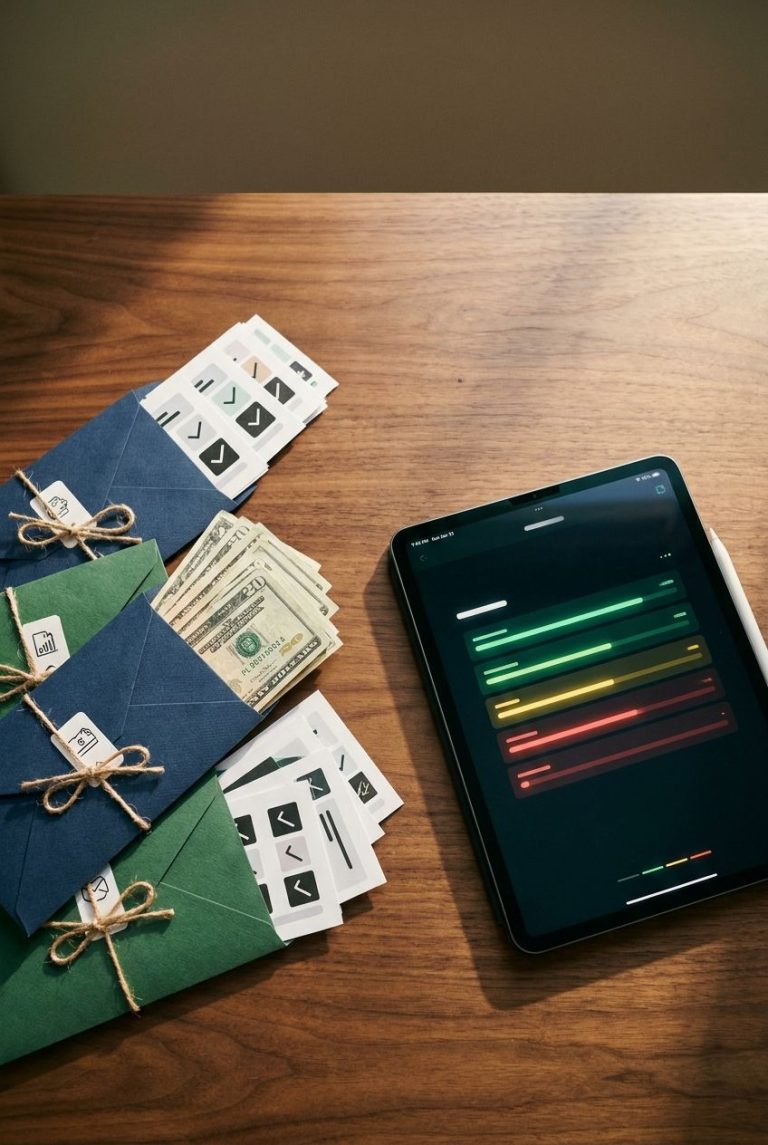
A biweekly budget treats each paycheck as its own mini-month. It’s more work upfront, but it matches money to timing, which is where most overdrafts happen.
- Mark your next 6 pay dates on a calendar. Paycheck every other Friday? Circle them all. Success looks like: seeing which 2 months get 3 paychecks.
- List every bill with its due date. Assign each bill to the paycheck that arrives right before it is due.
- Split large bills across checks. Rent of $1,400 due on the 1st? Set aside $700 from each of the two prior paychecks. But what if the first check of the month falls after the 1st? Start setting aside from the previous month’s second check.
- Set a fixed spending allowance per check. Example: $150 for groceries, $60 for gas, $50 for fun. Once it’s gone, it’s gone until the next check.
- Move the ‘bill money’ to a separate account the day you’re paid. This is the single habit that makes biweekly budgeting stick.
A worked example: Maya earns $2,000 per check. Rent ($1,400) is split into two $700 transfers. Utilities and insurance take $350 from check one and $200 from check two. That leaves her $950 for groceries, gas, savings, and spending in the first check and $1,100 in the second. Uneven? Yes. That’s why biweekly budgeting requires a bit of math upfront.
Monthly vs Biweekly Budget: Side-by-Side Comparison
| Criteria | Monthly Budget | Biweekly Budget | Hybrid (Monthly Plan + Biweekly Transfers) |
|---|---|---|---|
| Setup time | 30-60 minutes once per month | 20-30 minutes every 2 weeks (about 9 hours/year more) | 60 minutes once, then 5 minutes per paycheck |
| Overdraft risk with biweekly pay | Higher: bills can land before the money does | Lowest: every bill is pre-funded | Low: automation covers bills |
| Handles 3-paycheck months | Poorly unless you plan for them | Naturally, if you assign extra checks deliberately | Well: extra checks go to goals |
| Best for | Semi-monthly or monthly paychecks, steady income | Tight cash flow, paycheck-to-paycheck living, variable bills | Biweekly earners with moderate income |
| Main weakness | Ignores timing mismatches | More frequent effort, harder to see the big picture | Requires setting up automatic transfers |
Recommendation by situation: If you’re paid semi-monthly or monthly, use the monthly budget. If money is tight and you’ve overdrafted in the last six months, use the biweekly budget. If you’re paid biweekly and have a cushion of at least $1,000, use the hybrid method described below.

Why Does Pay Frequency Change Which Budget Works Best?
The question isn’t which method is smarter. It’s which one matches how cash actually enters your account.
When you’re paid monthly or semi-monthly
Your income looks the same every month, so a monthly budget maps cleanly. With semi-monthly pay on the 1st and 15th, you can pair bills to each check: housing and insurance from the 1st, car and utilities from the 15th. That’s a light version of biweekly budgeting inside a monthly frame.
When you’re paid biweekly
Your income arrives in a pattern of 2 checks per month most months and 3 checks twice a year. A pure monthly budget can’t see that pattern. In a two-check month, money gets tight if rent and a car payment land before the second check. In a three-check month, you feel flush and spend it.
When your income is irregular
Freelancers and gig workers should skip both and use a baseline budget: budget from your lowest earning month of the last 12, and treat anything above it as bonus money to allocate. Apps like YNAB’s ‘age your money’ feature help with this.
A rule of thumb: the more your paycheck timing and bill timing disagree, the more you need a biweekly element. If rent is due on the 1st and you’re paid on the 3rd and 17th, you’re always paying rent from last month’s money. That’s workable only with a plan.
How to Use the Two ‘Extra’ Paychecks Each Year
With biweekly pay, 26 paychecks fall across 12 months. Do the math: 26 divided by 12 is 2.17 paychecks per month. Two months per year contain three checks, which is roughly 8% of your annual take-home pay.

If you earn $2,000 per check, those two extra checks equal $4,000 a year. Treat them as regular income and they disappear. Treat them as a planned bonus and they change your finances.
A simple allocation for each extra check
- 50% to your top financial goal. Emergency fund first (target: 3 months of expenses), then debt with the highest interest rate.
- 30% to sinking funds. Car registration, holiday gifts, annual insurance premiums, vet bills.
- 20% to guilt-free spending. A trip, a purchase you’ve been postponing. This keeps the system sustainable.
How to know which months have three checks
Count forward from any known pay date in steps of 14 days. Write the 26 dates on a calendar. The months with three dates are your extra-check months. For many 2025 earners paid on alternating Fridays, these fall in months like May and October, but it depends on your first pay date, so check your own.
But what if you need that money to survive the month? Then your regular budget is too tight. Build your plan on 24 checks’ worth of income (26 minus the two extras) until you have a buffer, then redirect the extras.
The Hybrid Method: Monthly Planning With Biweekly Execution
Most biweekly earners do best with a hybrid. You plan like a monthly budgeter but move money like a biweekly one. Here’s the exact setup, which takes about an hour.

- Open a second checking account called ‘Bills.’ Many banks, like Ally or Capital One 360, offer fee-free accounts with no minimum balance.
- Calculate your total monthly bills. Say it’s $2,800.
- Divide by 2 and set an automatic transfer of $1,400 from each paycheck into the Bills account on payday. (Not by 2.17. Use 2, and let the extra checks be your bonus.)
- Point every bill’s autopay to the Bills account. Success looks like this: no bill ever depends on timing, because the money is already there.
- Leave the remainder in your main account as the spending pool for groceries, gas, and fun.
- On the two three-check months, route the third paycheck 100% to the allocation plan from the previous section.
But what if your bills are uneven? Some months have higher costs, such as a quarterly insurance bill. Add a sinking fund line: divide the annual amount by 24 and include it in each transfer.
The result is a monthly budget you design once and a biweekly workflow that runs mostly on autopilot.
5 Common Mistakes That Break Both Budgets (and Fixes)
- Mistake 1: Dividing a biweekly check by two to find monthly income. This undercounts pay by about 8%. Fix: multiply one paycheck by 26, then divide by 12.
- Mistake 2: Budgeting the 3-paycheck months as normal income. You’ll inflate your lifestyle for 10 months and feel squeezed in the other 10. Fix: budget on 24 checks, treat 2 as extras.
- Mistake 3: Using last year’s estimates for variable spending. Grocery prices rose roughly 20% between 2020 and 2024 according to US Bureau of Labor Statistics data. Fix: re-average your categories every quarter using the last 3 months.
- Mistake 4: No buffer in the checking account. Overdraft fees average about $27-35 per incident at major banks. Fix: keep a $300-500 cushion in your main account so small timing errors don’t cost money.
- Mistake 5: Never reviewing. A budget you don’t check is a guess. Fix: set a 15-minute weekly check-in, same day each week. Review actual vs. planned spending and move money between categories if needed.
Skip even one of these fixes and the budget leaks. The most expensive on the list is mistake 2, because it quietly costs you thousands per year.
What If My Income, Bills, or Pay Schedule Doesn’t Fit?
Real life rarely matches the template. These are the objections that come up most.
“What if my employer switches me to a different pay schedule?”
Rebuild your pay-date calendar the day you hear about it, and recalculate monthly income from the new frequency. Switching from biweekly to semi-monthly drops your check count from 26 to 24, but your annual pay stays the same, so each check gets larger. Update your automatic transfers immediately.
“What if I live paycheck to paycheck with nothing left over?”
Start with a pure biweekly budget. Your goal is not optimization. It’s a one-paycheck buffer: money that sits in your account so this month is funded by last month’s pay. Even $200 is progress. Build it by trimming one category by $25 per check, which gets you to $650 in a year.
“What if I have a partner with a different pay schedule?”
Combine incomes on a monthly view, then split bills into two groups: those paid from your account and those from theirs, matched to each person’s pay dates. Many couples use a joint account funded by transfers on both paydays. Review the plan together once a month for 20 minutes.
“What if budgeting feels like too much work?”
Automate the foundation and track only one number: your spending pool balance. If it’s above zero, you’re fine. That’s enough for most people to stay on track without tracking every coffee.
Your Next Step: Set Up the Hybrid Budget Tonight
Don’t spend a week researching apps. Take 30 minutes tonight and do these three things: open your pay stub, write down your next 6 pay dates and mark the two three-check months, then list your five biggest bills with their due dates.
Tomorrow, open the free Bills account at your bank and schedule the first automatic transfer for your next payday. That single transfer eliminates most of the timing problems between a monthly budget and a biweekly paycheck, and it takes less than 10 minutes to set up.