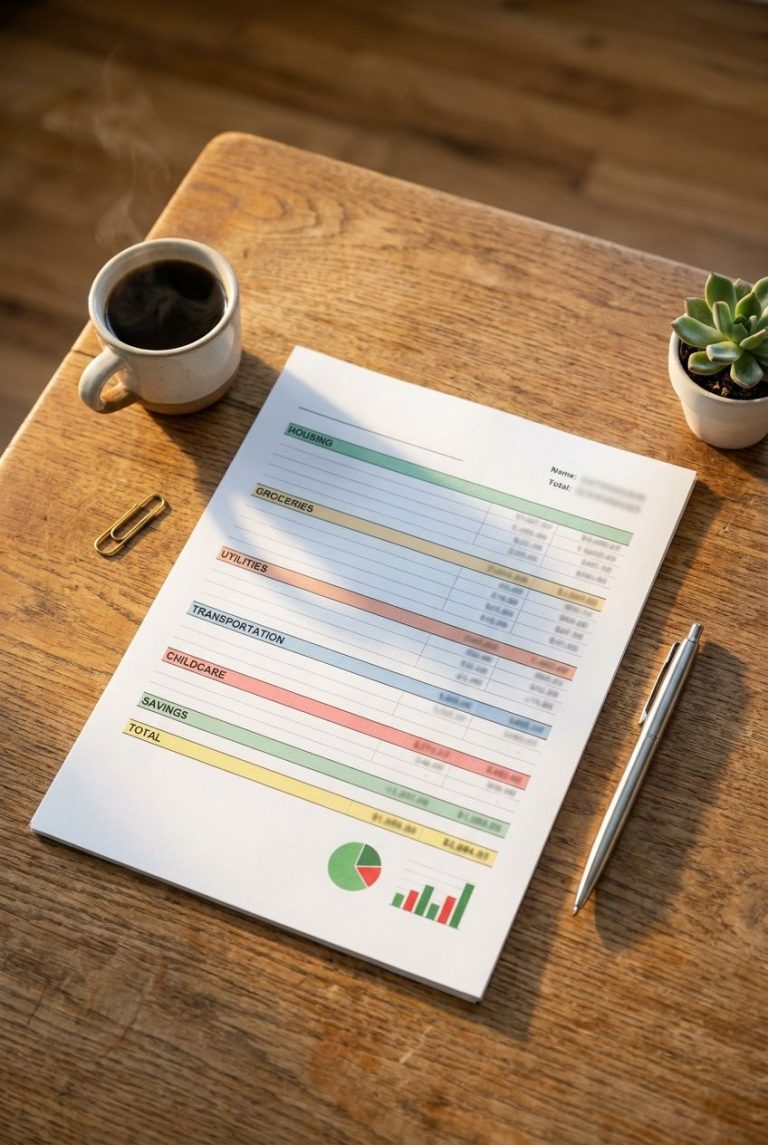
Monthly Budget Checklist for Beginners: 11 Steps to Take Control of Your Money in One Afternoon
Monthly Budget Checklist for Beginners: 11 Steps to Take Control of Your Money in One Afternoon
The average American household loses roughly $1,000 to $2,000 a year to money it never meant to spend: forgotten subscriptions, bank fees, and small purchases that never registered as decisions. A monthly budget checklist for beginners stops that leak. This guide gives you the exact steps, tools, and numbers to build one in about three hours, then maintain it in 30 minutes a month.
Why a Checklist Beats a Spreadsheet You Never Open
Most beginner budgets die in week three. People build an elaborate spreadsheet with 40 categories, feel proud for a weekend, then abandon it the first time a real expense breaks the plan.

A checklist works differently. It turns budgeting into a repeatable routine instead of a one-time project. You run the same steps in the same order every month, and each pass takes less time than the last.
What a budget actually is
A budget is a plan for your income before the month starts. It assigns every dollar a job: rent, groceries, debt payments, savings. The goal is not to restrict yourself. It is to decide on purpose instead of by accident.
How long it really takes
Expect about three hours for your first setup, mostly spent gathering statements and logging in to accounts. After that, a monthly review takes 20 to 30 minutes. If you spend more than that, you have too many categories.
One more thing before the steps: budgeting apps and spreadsheets are interchangeable. The best tool is the one you will open on the 1st of every month. Pick it later in this guide, not now.
Step 1-3: Gather Your Numbers Before You Plan Anything
You cannot plan with guesses. Spend your first hour collecting real data, because beginners consistently underestimate their spending by 15 to 25 percent when working from memory.
- Pull the last 90 days of statements. Download PDFs or CSV files from every checking account, savings account, and credit card. Three months smooths out irregular months. But what if you only have one month of history? Use it, then plan to revisit after month two with better data.
- Calculate your true monthly income. Use take-home pay, the amount that actually lands in your account after taxes and deductions. If you are paid biweekly, you get 26 paychecks a year, so multiply one paycheck by 26 and divide by 12. That is roughly 8 percent higher than doubling a paycheck, and two months a year you get a bonus third check. But what if your income varies? Use your lowest month from the past six as your baseline, and treat anything above it as extra for savings or debt.
- List every recurring bill with its due date. Rent or mortgage, utilities, phone, insurance, loan payments, subscriptions. Put each one in a simple list with the amount and the date. Success looks like a one-page list you could hand to a stranger.
Do not categorize anything yet. Resist the urge. Collection and judgment are separate jobs, and mixing them makes people quit.
Step 4-5: Sort Spending Into Four Buckets, Not Forty
Forty categories create friction. Four create clarity. Sort every transaction from your 90 days into one of these buckets:

- Needs: rent, utilities, groceries, insurance, minimum debt payments, transportation to work.
- Wants: dining out, streaming, hobbies, shopping, travel.
- Savings: emergency fund, retirement contributions, sinking funds.
- Debt payoff: anything above the minimum payment.
Add up each bucket and divide by three to get your monthly average. Now compare to the classic 50/30/20 rule, which suggests 50 percent needs, 30 percent wants, and 20 percent savings and extra debt payments.
How to read your result
If your needs run 60 percent or more, that is normal in high-cost cities. It just means your wants and savings share a smaller slice. Adjust the ratio to something like 60/20/20 rather than abandoning the framework.
But what if your numbers are far worse, say needs at 80 percent? Then the budget is not your problem. Your income-to-cost ratio is. Focus first on the largest single expense, usually housing, and on raising income, because trimming coffee will not close a 30-point gap.
Step 6-7: Set Spending Limits and Automate Savings First
Now you build the actual plan. The order matters: pay yourself first, then assign everything else.
Set the savings amount before anything else
Choose a dollar figure for savings and move it automatically on payday. Starting at even $50 per paycheck works. Set up a recurring transfer from checking to a high-yield savings account such as Ally, Marcus by Goldman Sachs, or Discover, which have recently paid around 4 percent APY compared to the 0.01 percent many big-bank accounts pay. On $5,000 saved, that gap is roughly $200 a year versus fifty cents.
Assign limits to the rest
For needs, use your actual bills. For wants, set a number about 10 percent below your three-month average. That small cut is realistic, while a 40 percent cut gets abandoned by day nine.
Use the envelope method for the leaky categories, usually groceries and dining out. Give yourself a fixed weekly amount, say $90 for groceries, on a dedicated debit card or in a cash envelope. When it is gone, it is gone.
But what if automation drains your account before bills clear? Schedule transfers for the day after payday, and keep a buffer of one week of expenses in checking. Success looks like checking never dipping below that buffer.
Step 8: Build a Starter Emergency Fund of $1,000 First
Every plan breaks without a cushion. The car needs new tires, the dentist finds a cavity, and suddenly the credit card is carrying $600 at 24 percent APR.
Start with a $1,000 starter fund. That covers the most common emergencies, which have a median cost around $500 to $1,500. Keep it in a separate savings account, ideally at a different bank than your checking so it is slightly harder to touch.
How fast can you build it?
Saving $100 a month gets you there in 10 months. Saving $250 gets you there in 4. If you receive a tax refund, which averaged about $3,000 in recent years, one deposit can finish the job.
The full-size target
After the starter fund, aim for three to six months of essential expenses. If your needs total $2,800 a month, that is $8,400 to $16,800. This takes years for most people, and that is fine. Progress counts more than the finish line.
But what if you carry credit card debt? Build the $1,000 first anyway. Without it, every surprise goes back on the card and you never escape. Then attack the debt aggressively before growing the fund further.
Step 9: Track Spending in 10 Minutes a Week
Planning means nothing without tracking. The cheapest method is a weekly 10-minute check, not daily obsession.
Pick a fixed time, like Sunday evening. Open your bank app, scan the week’s transactions, and compare each bucket to its limit. You are looking for one thing: are you on pace?
Choosing your tool
| Tool | Cost | Setup Time | Best For |
|---|---|---|---|
| Google Sheets or Excel | Free | 45-60 min | People who like control and customization |
| YNAB (You Need A Budget) | About $109/year | 1-2 hours | People living paycheck to paycheck who need every dollar assigned |
| Monarch Money | About $100/year | 30-45 min | Couples and people wanting automatic syncing and net worth tracking |
| Your bank’s built-in tools | Free | 10 min | Total beginners who want the lowest friction possible |
Recommendation: If you have never budgeted, start with your bank’s built-in tools or a free spreadsheet for 60 days. Only pay for YNAB or Monarch once you know the habit sticks. Paying $100 for an app you abandon in week two is the most common waste in personal finance.
Step 10-11: Prepare for Irregular Expenses and Review Monthly
The expenses that wreck budgets are not the ones you forgot. They are the ones that arrive twice a year or once every few years.

Create sinking funds
A sinking fund is a small amount set aside monthly for a known future expense. Divide the total cost by the months until it is due. A $600 car insurance premium due in 6 months means $100 a month. A $1,200 annual vacation means $100 a month.
Common sinking funds worth creating:
- Car maintenance and registration: $50 to $100 a month.
- Annual subscriptions and memberships: total yearly cost divided by 12.
- Gifts and holidays: $50 to $80 a month avoids the December credit card spike.
- Medical and dental: $25 to $50 a month for copays and prescriptions.
Run your monthly review
On the last day of each month, spend 20 minutes on four questions. Did you stay within each bucket? What was the biggest overspend and why? Did savings transfers go through? What needs adjusting next month?
Write one sentence of notes. After six months, those notes reveal patterns no app will show you.
3 Beginner Budget Mistakes That Quietly Ruin Your Plan
Almost everyone makes at least one of these. Knowing them in advance saves months of frustration.
- Setting a budget with zero fun money. Strict budgets feel virtuous for about two weeks, then collapse in a binge. Fix it by giving yourself a guilt-free allowance, even $40 to $100 a month, that needs no justification.
- Ignoring small recurring charges. A $12.99 streaming service, $9.99 cloud storage, and $14.99 app you forgot add up to $450 a year. Fix it by reviewing every subscription quarterly. Search your statements for recurring charges and cancel anything you did not use in the last 30 days.
- Quitting after one bad month. You will overspend. A wedding, a car repair, or a rough week will break a category. Fix it by treating a miss as data, not failure. Adjust the number, and carry on.
A fourth honorable mention: forgetting to budget for taxes if you freelance. Set aside 25 to 30 percent of every payment in a separate account, or April will hurt.
What If My Income Is Irregular, I Live With a Partner, or I’m Already in Debt?
The standard checklist assumes a steady paycheck and a single person. Real life is messier. Here is how to adapt.
If your income varies
Budget off your lowest recent month. When you earn more, use the extra in this order: top up the emergency fund, cover upcoming sinking funds, then pay down debt. Some freelancers also pay themselves a fixed monthly salary from a holding account, which smooths the swings.
If you share finances with a partner
Hold a 30-minute money meeting once a month. Decide on a shared bills account and keep individual spending accounts of equal size, so neither person has to defend a $12 purchase. Couples who talk about money monthly report fewer arguments about it than those who avoid the topic.
If you have debt
Pay minimums on everything, then throw every spare dollar at one target. The avalanche method targets the highest interest rate first and saves the most money. The snowball method targets the smallest balance first and builds momentum. If you carry a 26 percent credit card, choose avalanche. If you need quick wins to stay motivated, choose snowball.
Neither is wrong. The method you actually follow beats the optimal one you abandon.
Your Printable Monthly Budget Checklist
Once setup is done, this is the entire routine. Copy it into your notes app and run it every month.
Start of month (15 minutes)
- Confirm income: record expected take-home pay for the month.
- Verify automatic transfers: savings, debt payments, and sinking funds are scheduled.
- Check bill dates: note any bills that moved or increased.
- Set bucket limits: needs, wants, savings, and debt payoff in dollar amounts.
Weekly (10 minutes)
- Scan transactions: flag anything unfamiliar and dispute it fast.
- Compare to limits: are you on pace in the leakiest category?
- Adjust if needed: move money between categories rather than ignoring a miss.
End of month (20 minutes)
- Review results: total each bucket versus plan.
- Write one note: what worked and what to change.
- Check subscriptions: cancel one thing you no longer use.
- Celebrate progress: note your savings balance and emergency fund growth.
The whole cycle adds up to roughly 75 minutes a month. That is less time than most people spend scrolling past a single streaming menu.
Do This Today: Your First 30-Minute Win
Do not wait for a perfect afternoon. Open your bank account right now, download your last 90 days of statements, and set a calendar reminder titled “Money hour” for this Sunday at 6 p.m. That reminder is the whole system in miniature: a fixed time, a small task, and a habit that compounds.
When Sunday arrives, work through Steps 1 to 3 only. Tomorrow you can sort buckets. By the end of the week, you will have a working plan, and by the first of next month, you will run your first real checklist.